
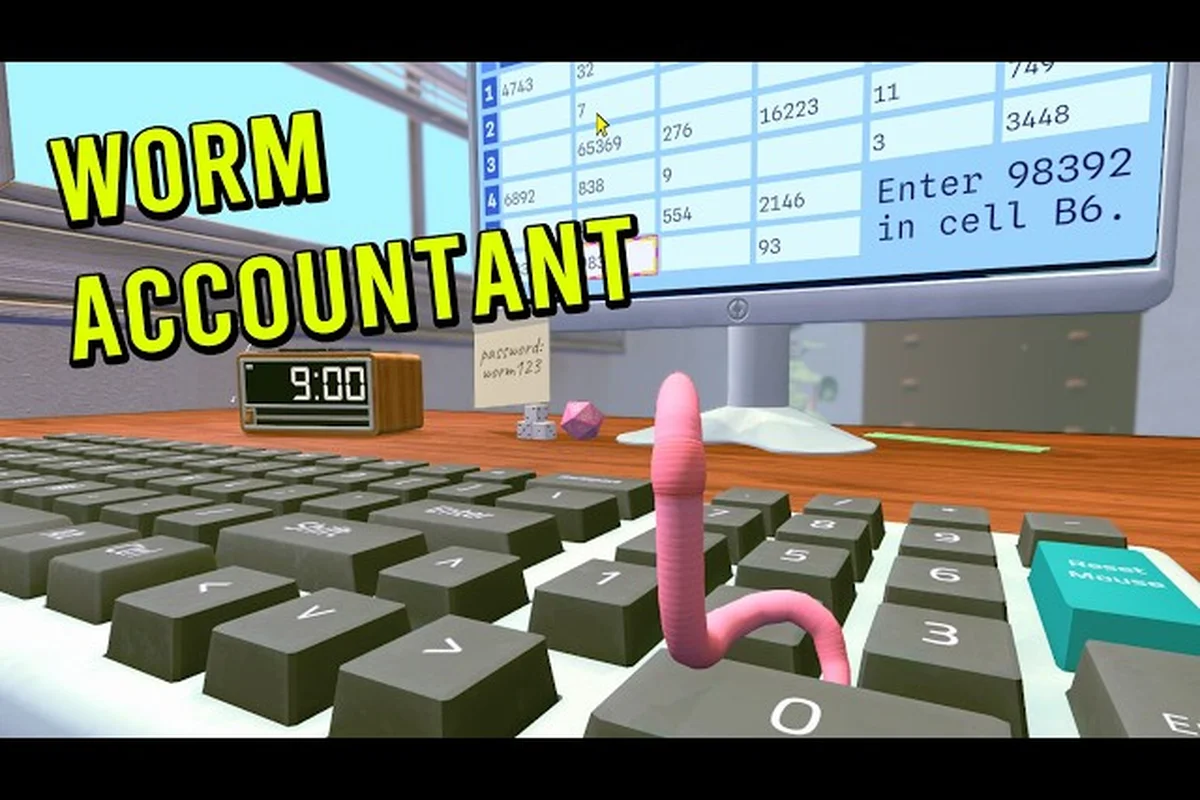
The Worming from Home stock market is where this silly worm job sim turns into a genuine money-printing machine, and understanding it early changes your entire run. Once you unlock it, passive income starts doing the heavy lifting while you wriggle around the office. This Worming from Home stock market guide breaks down exactly how to invest, when to buy stocks, and when to sell.
How the Worming from Home Stock Market Unlocks
The stock market is not available from minute one. According to the game's official Day of the Devs page, you spend your early hours bashing your spineless body across the keyboard to look busy, and the real wealth engine opens up later. Community reports on the Steam forums consistently say the Stock Market app unlocks roughly an hour into a run, right around the time the game pivots from active job sim into a full-blown idler.
That timing matters because it reshapes how you play. Before the unlock, your income comes from fake-work tasks, office chores, and grinding through the daily routine as a Junior Financial Analyst. After it, your interns generate passive cash while you watch charts climb. Players on the Steam community hub describe the shift as going from "doing work as a worm" to "watching stock charts all day," which is honestly the dream.
Here is the unlock checklist in rough order. Treat it less as a rigid sequence and more as a priority stack: the Junior Financial Analyst promotion path and the Stock Market app purchase both route to the same destination, so the fastest runs are the ones where you funnel every early paycheck toward whichever trigger comes first. Steam forum players who rush the unlock report reaching the market around the 45-minute mark, while players who split income between office upgrades and stocks can slip past the 90-minute mark. Keep your worm's fake-work output steady until the app appears on your in-game desktop, because the pre-market grind is what funds your first positions.
-
Complete early office tasks to earn your first paycheck
-
Buy the Stock Market app or trigger the promotion milestone that grants it (community reports vary slightly on the exact trigger)
-
Open the app from your in-game desktop alongside Messages, Video Call, Spreadsheet, and Printer
-
Start small — your first few hundred dollars matter more than you think
If you are still working through the opening hours, our Worming from Home beginner guide covers the pre-market grind in detail, including how long the early game typically takes. The short version: prioritize Spreadsheet tasks over Printer chores, since Spreadsheet work pays out roughly twice per in-game day and compounds faster toward the Stock Market app's purchase price. Once the app icon appears on your desktop next to Messages and Video Call, resist the urge to dump your entire first paycheck into a single position — a split across two stocks gives you a safety net while you learn how the charts move.
Worming from Home Stocks Explained: How Prices Actually Move
Before you throw money at charts, you need the mechanics. Worming from Home stocks explained simply: each stock has a current price, a price-change percent shown next to it, and a daily update cycle. Prices refresh on a regular in-game schedule, and the change percent tells you whether a stock trended up or down since the last tick.
The daily update cycle
Community testing suggests stock prices update once per in-game day, which means there is no benefit to staring at the app between refreshes. This is the single most common misunderstanding new players have — they treat it like a real-time trading floor when it behaves much more like a once-a-day lottery with a skill component layered on top. Plan your buys and sells around the reset, not around minute-to-minute movement.
Reading the change percent
The stock change percent is your main decision signal. A stock showing a strong positive percent has momentum; a deeply negative one may be discounted or may simply be in freefall. Because the game gives you insider information through the Messages app (more on that below), the percent alone should never be your whole strategy — it is the baseline, not the answer.
| Signal | What it means | Recommended action |
|---|---|---|
| Positive change percent + insider tip | Expected rise confirmed | Buy before the next daily update |
| Positive percent, no tip | Momentum, but uncertain | Small position, low risk |
| Negative percent + insider tip | Tip says rise is coming | Buy the dip aggressively |
| Negative percent, no tip | Unknown trajectory | Wait for the next update |
| Big run-up already priced in | Late entry risk | Consider selling to lock profit |
If you want a deeper dive into the numbers, our breakdown of Worming from Home stock value and change percent walks through how daily ticks compound across a full run.
How to Invest: Your First Portfolio
Worming from Home how to invest is refreshingly simple once the app is open. You pick a stock, choose a share quantity, and confirm the purchase. Cash leaves your account instantly, and shares sit in your portfolio until you sell. There are no fees, no margin, and no partial fills — the game keeps trading friction near zero so the strategy lives entirely in timing and information.
Starting capital strategy
Your first investments should come from a mix of your salary and early task income. Community players recommend keeping a small cash buffer rather than going all-in immediately, because a bad daily tick with zero liquidity leaves you stuck waiting for a recovery. A reasonable split for the first week of trading looks like this:
| Portfolio stage | Cash reserve | Invested | Reasoning |
|---|---|---|---|
| First unlock | 50% | 50% | Learn the update cycle safely |
| After 3-4 days | 30% | 70% | Patterns and tips become readable |
| Mid-game with interns | 10-20% | 80%+ | Passive income covers emergencies |
| Late game | Near 0% | Everything | Compound growth dominates |
Interns and passive income
The Interns system is the quiet MVP of your investing career. One progression path, Valuable Work Experience, involves buying 10 interns, who generate money while you do literally anything else — including sleeping, gym-training your Muscle Mass perk tree, or reading in the Reading Nook to level Financial Insight. That last one matters: community players report that Financial Insight improves your read on the market, making your buy decisions meaningfully sharper over time.
The idler loop is intentional. As one Steam community reviewer put it, after about an hour the game becomes watching stock charts while your interns make passive income for you. Lean into it — every dollar of passive income is a dollar you can dump into shares at the next daily reset.
Technis Corp and the Insider Information Loop
Now for the fun part: Technis Corp. is the game's flagship stock, and it sits at the center of the insider trading mechanic that defines the whole experience. Rob's Game Shack describes the loop perfectly — you game the stock market with insider tips you definitely shouldn't have, all while your boss Steve thinks you're being productive. It is corporate fraud, but worm-shaped, so it's fine.
How insider tips arrive
Insider information lands in your Messages app, usually from colleagues like Trevor or M, hinting that a stock — very often Technis Corp. — is about to move. The tips are not decorative flavor text. Acting on them is the difference between slow compound growth and obscene overnight gains, and the game's own marketing leans into it: the official Day of the Devs listing explicitly says you invest in the stock market to "earn obscene amounts of money."
The insider trading workflow
The insider trading loop in Worming From Home rewards discipline over speed: a tip that arrives mid-shift is only as good as your execution window, so treat each one as a timed event rather than a casual suggestion. Because hints reference the next price update, hesitation costs real money — a Technis Corp tip acted on immediately might net a 15–20% spike, while the same tip sold one tick late can shrink to single digits. Before you commit cash, mentally run the checklist below so every trade follows the same repeatable pattern instead of gut feel.
-
Read the tip the moment it arrives — hints reference the next price update
-
Cross-check the named stock's current change percent before committing
-
Buy as many shares as your cash reserve allows before the daily reset
-
Sell into the spike on the following tick, then redeploy into the next opportunity
-
Bank profits into interns and perk upgrades between tips to keep the flywheel spinning
Our full Technis Corp stock and insider information guide covers the tip sources, colleague relationships, and best stock picks in much more depth if you want to squeeze every dollar out of the loop.
When to Buy Stocks: Timing Rules That Actually Work
Worming from Home when to buy stocks comes down to three signals working together: the daily reset clock, the change percent, and whatever your messages are whispering. Because prices only move once per day, your buy window is effectively the stretch between a fresh reset and the next one — but the quality of a buy varies enormously within that window.
The three buy signals ranked
Not every buy opportunity in the worming from home stock market carries the same weight, and the community's collective trading experience points to a fairly consistent ranking. What separates a strong entry from a weak one is how much information you actually have before committing cash: an insider tip tells you the direction, the current percent tells you whether you're paying a discount or a premium, and combining both is what produces the near-guaranteed outcomes summarized in the table below.
| Rank | Signal | Confidence | Typical outcome |
|---|---|---|---|
| 1 | Insider tip + negative percent | Very high | Strong spike next tick |
| 2 | Insider tip alone | High | Reliable rise |
| 3 | Positive momentum, no tip | Moderate | Coin flip with better odds |
The best play is almost always buying a tipped stock while its percent is still negative. You get the discount and the guaranteed direction, which is the closest thing to free money the game offers. When no tip is active, momentum-buying a stock with a healthy positive percent is acceptable, but size the position smaller because you are genuinely guessing.
Timing around the reset
Since prices update daily, the optimal routine is simple: check messages first thing each in-game day, scan the market app second, and commit your cash before you get absorbed in office tasks. Players who check the market last often miss the ideal entry because the reset has already repriced their target. Build the habit of a morning market scan and your returns will thank you.
When to Sell Stocks: Locking In Profits Without Getting Greedy
Worming from Home when to sell stocks is where most players leak money, because the same daily tick structure that makes buying easy also tempts you into holding one tick too long. The core rule: sell into the spike, not after it. When a tipped stock jumps on the next update, that jump is already fully priced in — the next tick is a fresh roll of the dice, not a continuation of your good luck.
The sell decision framework
The framework works because it removes emotion from the moment of decision — by the time a position is live, your judgment is already compromised by sunk-cost thinking and the fear of missing the next tick. Instead of agonizing over each sale, run the situation through this table: is the stock tipped, untipped, flat, or superseded by a fresh insider tip? Each state maps to one action, so a tipped stock that spiked after your buy gets sold fully, while an untipped stock riding two consecutive ticks only gets trimmed. Apply it mechanically every time a position moves, and the table below tells you exactly what to do in each case.
| Situation | Action | Why |
|---|---|---|
| Tipped stock spiked after your buy | Sell everything | Profit is realized; next tick is uncertain |
| Untipped stock gained 2+ ticks in a row | Sell half | Momentum exists but is fading |
| Stock flat for 3+ ticks | Sell and redeploy | Dead capital earns nothing |
| New insider tip names a different stock | Sell whatever funds the new buy | Opportunity cost beats loyalty |
| Market-wide crash reported | Hold quality positions or cut losers | Community reports vary on crash recovery |
That last row deserves a note: community players describe occasional market crash events where broad dips hit multiple stocks at once. Panic-selling during a crash usually locks in losses, while holding solid positions through the dip tends to recover — though exact crash behavior may vary by version, so treat this as community-reported rather than confirmed.
Reinvesting instead of hoarding
Cash sitting in your account earns nothing; shares and interns compound. The strongest late-game pattern reported by players is a full rotation cycle — sell the spike, immediately buy the next tipped or momentum stock, and keep only a thin cash reserve for emergencies. Our guide on investing in the late game and compound growth covers the bank-versus-stocks question and how far you should push the all-in strategy.
Late-Game Money: From Comfortable to Obscene
Once your rotation loop is humming, the Worming from Home stock market stops being a side mechanic and becomes the whole point of your run. Passive intern income feeds daily buys, insider tips supercharge individual ticks, and Financial Insight upgrades make your untipped reads sharper. The compound effect is dramatic — players report going from modest salaries to absurd wealth within a few in-game weeks of disciplined rotation.
A few advanced habits separate good portfolios from great ones, and most of them come down to timing discipline rather than raw cash. Knowing when to buy stocks versus when to sell stocks matters more than volume — dumping a tipped position the moment its spike flattens frees capital for the next insider lead, while holding through the plateau just ties up money your interns could be multiplying. The same logic applies to untipped ticks: buying Technis Corp. or another steady performer on a dip and selling into its regular bounce nets a reliable margin without ever risking a stale tip.
-
Never let a tip expire unread — an ignored hint is pure lost profit
-
Upgrade income generators between tips, since interns and perks pay for themselves across every future rotation
-
Track which stocks tip most often — community players note Technis Corp. appears in hints frequently, making it a reliable default when you have spare cash and no active lead
-
Balance the life sim side — the gym, the Reading Nook, and the romance line with M all feed back into your earning power, so pure chart-watching is actually suboptimal
The beauty of the system is that it rewards exactly the kind of lazy, scheming office-worm fantasy the game is built around. You barely work, you constantly commit light financial crimes, and Steve never suspects a thing. For a look at the game's broader loop and community reception, the Worming from Home page on Rob's Game Shack gives a solid independent overview of how the job sim and market mechanics fit together.
Frequently Asked Questions
How do I unlock the stock market in Worming from Home?
The Stock Market app unlocks roughly an hour into a run, according to community reports on Steam, around the time the game shifts into its idler phase. Keep completing office tasks and progression milestones, and the app will appear on your in-game desktop alongside Messages and the other work tools.
Is Technis Corp. the best stock to buy?
Technis Corp. is the most frequently tipped stock, which makes it the most reliably profitable when insider information is active. Without a tip, it behaves like any other stock, so treat it as your default pick for spare cash but never skip a stronger tipped opportunity on a different ticker.
When should I sell my shares for maximum profit?
Sell immediately after a tipped stock spikes on the next daily update, because the gain is already priced in and the following tick is uncertain. For untipped momentum plays, take profits after two consecutive positive ticks, and always redeploy the cash rather than letting it sit idle in your account.
Do stock prices update in real time?
No. Community testing indicates prices refresh once per in-game day, so there is nothing to gain from watching the app between resets. Build a routine of checking messages and the market at the start of each day, then get on with your office duties until the next cycle.
Can I lose money on the Worming from Home stock market?
Yes, especially on untipped momentum buys, since those are essentially educated guesses. The insider information loop dramatically reduces risk when you act on tips quickly, and keeping a small cash reserve protects you from being stuck if a market crash event dips your whole portfolio at once.