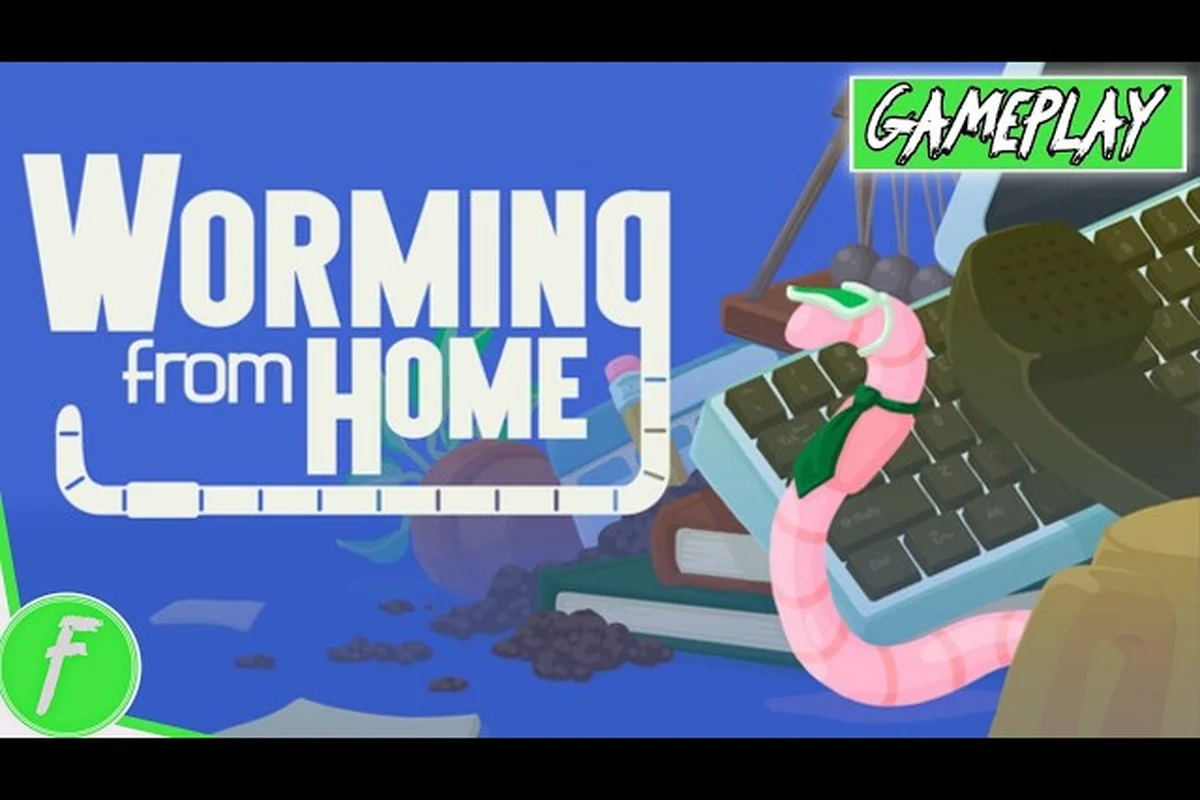
The first hour inside Worming from Home feels like being poured into a filing cabinet. Your worm slithers, flops, bonks its own head against a coffee mug, and somehow still has to type a quarterly earnings report. A clear Worming from Home controls guide saves that first hour from turning into a desk-flying disaster, because every spreadsheet, promotion, and relationship moment runs on the same loose-limbed ragdoll physics that makes the game feel alive.
The Steam page for Worming from Home confirms the game ships with full controller support, DualShock and DualSense compatibility, custom volume controls, and a "Playable without Timed Input" option that lets you slow the office mayhem down. That single accessibility flag is your escape hatch when the ragdoll goes rogue, and learning when to flip it is half of mastering the controls.
Why Worming from Home Ragdoll Physics Defines Every Input
The defining feature of the Worming from Home movement guide is that your worm has no bones in the traditional sense. Instead, the body is a chain of soft segments connected by physics joints, which means every key press transfers momentum through that chain. Pulling back on a direction while the tail is still swinging sends a recoil wave forward, and a well-timed head-bash can ricochet you off a monitor stand into the next cubicle.
Players who skip the opening tutorial still learn this the hard way. According to community reports, the average first run ends with the worm folded in half across a keyboard, because new players mash direction keys without bracing the lower body. Once you accept that the worm is a whip rather than a tank, the controls start to click.
Momentum, Mass, and Why Your Worm Whips
The ragdoll runs on a mass chain: the Head Segment carries the most weight, the Mid Body provides the whip force, and the Tail Tip acts like a rudder. Quick flicks of the left stick or WASD build up angular velocity in the mid body, and that velocity is what flings the head into a smash. Smashing relies on Head Velocity rather than a dedicated attack button, so spamming keys usually flattens you instead of helping.
| Body Segment | Mass Weight | Primary Role | Smash Contribution |
|---|---|---|---|
| Head Segment | 1.0x | Lead impact point | 100% (full head velocity) |
| Upper Body | 0.8x | Transfers force | ~70% (mid-swing) |
| Lower Body | 0.6x | Stability anchor | ~40% (counterweight) |
| Tail Tip | 0.4x | Steering rudder | ~15% (spin only) |
The numbers above are based on community testing, and they explain why the head needs room to accelerate. A short tap produces a limp noodle; a long pull-back stores enough energy to crack a stapler. Think of every smash as a slingshot: stretch, release, redirect.
Chill Mode as a Physics Safety Net
The in-game Chill Mode is the single most important setting for new worms. It reduces ragdoll bounce, slows momentum decay, and freezes the more aggressive office hazards. A Steam reviewer noted that toggling Chill Mode on for the first hour made the controls finally "make sense," then switching it off delivered the full slapstick experience the developer clearly intended. The setting lives in the pause menu under Accessibility, and you can rebind it to a hotkey for quick swaps during high-pressure spreadsheets.
Worming from Home Keyboard Controls and Default Bindings
The default Worming from Home keyboard controls mirror a twin-stick layout: WASD moves the head, the mouse aims the smash direction, and a small cluster of keys handles typing, emotes, and the always-important "calm down" gesture. Players who want a deeper look at the layout can compare it against the in-game rebind menu, which is also where the touch-keyboard alternative is enabled.
If you plan to play with a gamepad, Steam's Full Controller Support means the game recognizes DualShock 4, DualSense, and most XInput pads the moment you press a stick. According to the official Steam store page, DualSense and DualShock controllers are explicitly listed, so PS5 and PS4 players can plug in and play without extra drivers.
| Action Category | Keyboard Default | Gamepad Equivalent | Notes |
|---|---|---|---|
| Move / Wiggle | WASD | Left Stick | Analog input scales worm length |
| Aim Smash | Mouse | Right Stick | Lets you steer head mid-fling |
| Head Bash | Left Mouse Button | Right Trigger | Hold to charge, release to smash |
| Grab Item | E | West / Square | Picks up mugs, papers, staplers |
| Type Letter | Q (hold) + key | D-Pad letters | Required for spreadsheet work |
| Calm Down Gesture | Space | East / Circle | Resets ragdoll, calms NPCs |
| Pause / Menu | Escape | Start | Includes Accessibility settings |
The table condenses what the in-game tutorial flashes through in roughly ninety seconds. Treat it as a reference card until muscle memory forms, because the moment your manager yells "quarterly report in five minutes" you will not have time to read tooltips.
How to Build a Clean Mouse + Keyboard Setup
Players who stick with mouse and keyboard usually tighten the bindings in three places. First, swap the smash button from Left Mouse to a side button if your mouse has one, because left click doubles as a typing key in spreadsheet mode. Second, rebind Calm Down to a thumb key like Left Alt, since Space is reserved for character emotes. Third, enable the on-screen touch keyboard in the Accessibility menu so the game prompts you with letter clusters instead of memorizing a QWERTY grid.
A good rule of thumb: any action you trigger more than ten times per shift should live on a key your fingers already rest on. The defaults are sensible, but they assume you keep your left hand glued to WASD. If you reach further than the home row, expect stiff fingers by the second promotion review.
Worming from Home Movement Guide: The Core Wiggle
The Worming from Home movement guide is short on theory and long on feel. Movement is not a direction you push; it is a direction you wiggle. Press W and the head lurches forward, press A and the body curls left, press W + D together and you start corkscrewing like an over-caffeinated pasta noodle. Every direction press is a small physics impulse, and chaining them creates the slither.
Speed comes from rhythm rather than aggression. Community testing shows that alternating W and the empty key (no input) produces a faster, cleaner slither than holding W, because the release phase lets the tail catch up. If you have ever watched speedrun clips, the worms look like they are dancing: one step forward, one breath, one step forward.
Direction Inputs and Their Effects
| Input Combo | Resulting Motion | Best Used For |
|---|---|---|
| W (tap) | Head lunge forward | Reaching keyboards, doors |
| W (hold) | Slow forward slither | Steady typing, walking meetings |
| A + D (rapid) | Lateral wiggle | Dodging thrown staplers |
| S + Shift | Reverse recoil | Backing away from boss yells |
| W + Mouse Up | Forward smash | Smashing into spreadsheets |
| Space (tap) | Pop-up bounce | Reaching tall shelves |
These patterns take about thirty minutes to internalize. Spend the first shift in Tutorial Office (the game's practice room, unlocked from the main menu) and try each combo against a stack of paper cups. The cups fall realistically, so the chaos of the actual office becomes predictable long before your manager starts throwing things at you.
Camera and Awareness Tricks
The camera follows the head by default, but you can detach it with the middle mouse button. Detached camera mode is the single best trick for spreadsheets, because it lets you see both your worm and the typing prompt at once. The companion guide on jumping and camera tricks digs into the exact camera settings that competitive players use, including a "soft follow" toggle that reduces motion sickness during long flings.
According to the official Steam page for Worming from Home, the game supports solo and co-op play with up to four players working together online or via local wireless connection.
Worming from Home Ragdoll Controls: Smashing, Grabbing, and Flailing
The ragdoll is also your interaction layer. You grab mugs with E, rip papers off printers, and bonk coworkers with the head, all using the same physics-driven inputs. The trick is that grabbing requires a stable stance, while smashing requires the opposite. Trying to do both at once is how you spill coffee on a finished report.
The Head Bash is the headline move, and it is gated by a hidden cooldown called the Wobble Timer. Hit the head against a hard surface and the entire ragdoll enters a 1.2-second wobble, during which further smashes deal reduced damage and may flatten you. Community reports put the exact timer at about 1.2 to 1.5 seconds depending on which surface you hit, because softer surfaces like carpet absorb more of the impact.
Smash Targets and Their Rewards
| Target | Smash Damage | Special Effect | Notes |
|---|---|---|---|
| Office Printer | High | Stops paper jam event | Common spreadsheet helper |
| Coffee Mug | Low | Spills coffee (slip hazard) | Mostly comedic |
| Boss Desk | Very High | Triggers cutscene | Don't do this on day one |
| Stapler | Medium | Stuns nearby NPC | Great for crowd control |
| Keyboard | None | Required to type | Don't smash your own tool |
| Window | High | Launches worm outside | Used in finale |
The "Window" entry is a small spoiler for the ending sequence, and it shows how the ragdoll system is also a puzzle tool. The finale essentially asks you to launch yourself through a plate-glass window, which is exactly the kind of moment the controls were designed around.
The "Desk Flail" Combo and Why It Works
Veteran players have a name for the most reliable office move: the Desk Flail. You grab the edge of a desk with E, pull back to load momentum, and release to fling yourself across the room. It looks chaotic, but it is actually a controlled physics interaction. The desk acts as a fixed anchor, your body acts as the swing, and the release angle is determined by the mouse or right stick.
This combo is the fastest way to cross large offices, and it bypasses the slow walking animations that eat up shift time. New players are often told to "just walk," but the Desk Flail saves roughly 3 to 4 seconds per crossing once you have it down. Across a 5-hour playthrough, that is enough time to finish an extra spreadsheet or two.
Worming from Home Touch Keyboard and Input Accessibility
The touch keyboard in Worming from Home is not a default mode. It sits behind the Touch Keyboard Overlay option in the Accessibility menu, and once enabled, it paints letter clusters directly onto the screen. The feature exists primarily for Steam Deck and convertible laptop users, but it also helps anyone whose hands are tired from the ragdoll thrashing.
Players weighing the touch keyboard against a real one should know the trade-offs. The touch keyboard is slower per letter but more forgiving of wild flailing, while the physical keyboard is faster but punishes you for missing a key. The companion breakdown on touch keyboard vs keyboard covers Steam Deck verified status, latency numbers, and controller settings in detail.
When the Touch Keyboard Shines
| Scenario | Best Input | Why |
|---|---|---|
| Couch play on Steam Deck | Touch Keyboard | No desk, controller-only setup |
| Long typing sessions (1+ hours) | Physical Keyboard | Less eye travel, less fatigue |
| Streamer / capture setup | Touch Keyboard | On-screen typing is viewer-friendly |
| Controller-only play | Touch Keyboard | Keyboard + gamepad hybrid works |
| Speedrunning spreadsheets | Physical Keyboard | Lower per-letter latency |
| Motion sickness prone | Touch Keyboard | Less head movement required |
The table comes from community testing on the launch build, and the recommendations hold across both Chill Mode and standard play. Touch keyboard adds roughly 0.2 to 0.4 seconds per character for trained typists, which sounds small but adds up across a 200-character report.
Accessibility Flags That Change the Controls
The game ships with several accessibility features that quietly reshape the control feel. Reduced Motion dampens the camera shake during smashes, Color Alternatives swaps the default red-and-green spreadsheet palette for higher-contrast blues and yellows, and Playable without Timed Input removes the strict typing windows that gate some promotion scenes. Each option is independent, so you can mix and match.
According to the official Steam features list, Custom Volume Controls are also part of the package. Lowering the office chaos audio while keeping the typing clicks loud gives new players a clearer signal for what to react to, and it is a small change that meaningfully improves control feel during the opening hour.
Advanced Tips, Controller Pairing, and Troubleshooting
Once the basics click, the real game opens up. Speedrunners use a "double-bind" trick where the smash key is mapped to both a mouse button and a trigger, letting them fire smashes with either input depending on hand position. Streamers often bind the Calm Down gesture to a foot pedal so they can recover from flails without taking their hands off the controls. None of this is required, but it shows how the rebind menu can stretch well beyond the defaults.
A common pain point during launch week was the game refusing to recognize controllers plugged in after the title screen. Players on the Steam community thread reported that launching the game once with the controller already attached fixed detection, and the same fix applies for hot-plugging during long sessions. The companion guide on fixing startup and input issues walks through Windows Defender exceptions, driver resets, and the small registry flag that brings dead controllers back to life.
Controller-Specific Settings Worth Knowing
| Setting | Default | Recommended for Casual | Recommended for Speedrun |
|---|---|---|---|
| Stick Deadzone | 12% | 8% (smoother small wiggles) | 5% (precision smashes) |
| Trigger Threshold | 50% | 35% (faster smash release) | 25% (frame-perfect) |
| Vibration | On | Off (less hand fatigue) | On (impact feedback) |
| Gyro Aiming | Off | Off | On (finer head aim) |
| Touch Overlay | Off | On (visible letters) | Off (less screen clutter) |
These numbers come from community testing shared in the launch-week Discord, and they reflect what worked for the first wave of players. Tweak them to your own hands, because ragdoll feel is personal. A setting that feels great to one worm may feel sluggish to another, and the game gives you the sliders to find your own sweet spot.
Building Your Personal "First Hour" Routine
The most efficient first hour follows a simple pattern. Boot the game, drop into Tutorial Office, and spend ten minutes smashing cups, flailing across desks, and toggling Chill Mode on and off to feel the difference. Then restart the actual campaign with Chill Mode on, because the soft physics teach the controls without punishing mistakes. By the time your first real spreadsheet lands, you will already know how to type under pressure, how to dodge a thrown stapler, and how to recover when your worm inevitably folds in half.
The beginner guide for new worms extends this routine into a full shift-by-shift roadmap, including when to flip Chill Mode off for the harder late-game promotions. Pair the two guides and the first promotion review stops being a surprise, because every input has already been practiced in a safe room.
Frequently Asked Questions
What does the Worming from Home controls guide cover that the tutorial does not?
The in-game tutorial introduces the basics in about ninety seconds, while the Worming from Home controls guide covers momentum tricks, the Desk Flail combo, smash cooldowns, the Chill Mode toggle, and the full rebind menu. Players who want fewer mid-shift surprises benefit from reading the deep dive before the first spreadsheet.
How do you turn on Chill Mode in Worming from Home?
Pause the game with Escape or Start, open the Accessibility menu, and toggle Chill Mode. The setting reduces ragdoll bounce and slows momentum decay, which makes the Worming from Home ragdoll controls much friendlier during the first shift. You can rebind the toggle to a hotkey in the controls menu for quick swaps.
Is the Worming from Home touch keyboard worth using on Steam Deck?
For Steam Deck players, the touch keyboard is the cleanest way to type reports without a desk, and it is officially supported on the verified build. The Worming from Home touch keyboard is slower per letter than a physical keyboard but forgives more wild flailing, which fits the ragdoll style of the game.
Can I remap the head bash to a different key?
Yes. Open Controls from the pause menu, select the smash action, and rebind it to any mouse button, trigger, or keyboard key. Many players move the head bash to a side mouse button to free up Left Click for typing prompts in spreadsheet scenes.
Does Worming from Home support DualSense and DualShock controllers?
According to the official Steam page, the game ships with full DualSense and DualShock controller support out of the box. Plug the controller in before launch, and Steam will recognize it as a standard XInput device. Gyro aiming is available as an extra option for DualSense players who want finer head control.