
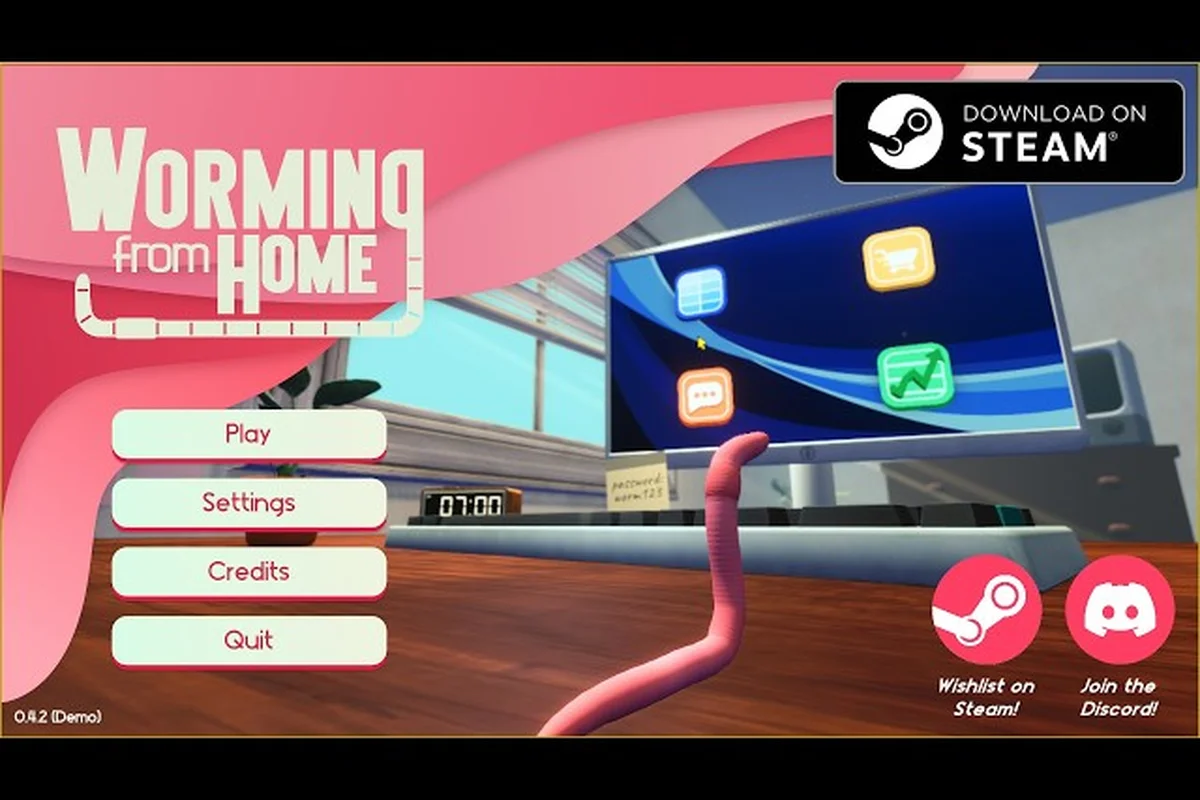
Worming from Home key bindings define how your ragdoll worm reaches every key on the desk, so dialing in the right remap layout turns a frustrating first shift into smooth spreadsheet work. Because the entire game is played by physically throwing a spineless body onto individual keys, the default Worming from Home key bindings matter far more than in a typical keyboard-mouse sim. This guide covers how to remap keys, which actions need the most accessible slots, and the minimum system requirements your PC needs to keep frame rates stable while your worm slithers across the keyboard.
Wand's review highlights that the default Worming from Home key bindings intentionally anchor the highest-frequency inputs — Grab, Release, and Stretch — to the home row, so even unmapped players stay within finger's reach of every action. Because the worm has no independent movement and must physically drape over keys like F, J, and the spacebar, that ergonomic choice is what separates a clean shift from a tangle of stretched-out limbs knocking over the coffee mug. It also explains why most remap guides recommend keeping one modifier, such as Shift, reserved for the Stretch command, leaving the core WASD zone untouched.
How the Worming from Home Control Scheme Maps Inputs
The default control scheme in Worming from Home is purpose-built around the gag: your worm has no hands, so every input is a literal key press delivered by bouncing a ragdoll onto a physical key on the on-screen keyboard. According to the official Steam store page, you "wriggle your way up the corporate ladder" by hitting keys individually to answer messages, fill out spreadsheets, and complete daily tasks as a junior financial analyst. The default key bindings lean on a wide spread of letter keys so the physics engine has room to feel chaotic, but the same spread makes precise work surprisingly tricky until you remap.
How the Default Layout Maps to Game Actions
The default layout assigns each major in-game action to a specific letter or number key that the ragdoll worm must strike. The table below summarizes the most common bindings, what they do, and how urgently you should consider remapping each one.
| Action | Default Key | Why It Matters | Remap Priority |
|---|---|---|---|
| Confirm / Send Message | Enter | Used dozens of times per shift | Low (already well-placed) |
| Cancel / Backspace | Backspace | Frequent typo correction | Low |
| Type a Letter | A–Z | Each character requires a hit | High (cluster matters) |
| Type a Number | 0–9 | Used in spreadsheets and phone dialing | Medium |
| Tab to Next Field | Tab | Cycles through spreadsheet cells | Medium |
| Shift | Left Shift | Capitalization for emails | Low |
| Space | Spacebar | Common in messages | Medium |
Players who have logged time on the early days report that the left side of the keyboard (A, S, D, F, Q, W, E, R) sees the most traffic, while the right side rarely gets hit unless you are doing math-heavy tasks. A community review noted that the game's "main points of interest are your keyboard and mouse" and that you need to "crawl onto the keyboard and hit each key individually," which is exactly why a remap pass pays off once you have a feel for the physics.
Why the Defaults Can Feel Awkward
The default scheme was chosen for visual comedy rather than ergonomics, because watching a worm flail across a wide QWERTY spread is the central joke. The trade-off is that letter keys spread across the whole board, so a long word like "FINANCE" requires your worm to slither from F to I to N and so on. Community testing shared on the Steam discussions suggests that clustering your most-used letters into one hand zone (for example, the left home row) reduces the average physics travel distance and keeps frame rates steadier because fewer ragdoll collisions occur far from the camera focus.
Remap Keys in Worming from Home: Step-by-Step
Worming from Home exposes a remap menu inside the pause screen, so you never need to edit a config file or use external software. According to the game's settings, the rebind UI is designed for mouse-only navigation, which means even when you are mid-shift you can pause, reassign, and resume without quitting the program. The remap flow is short, but the order of operations matters because some bindings conflict with each other.
According to the worming from home key bindings guide at report.wand.com, players can customize their controls to streamline the process of managing virtual worm habitats directly from their keyboard.
According to the Worming from Home review on Report Wand, the key bindings can be fully customized from the in-game settings menu, allowing players to rebind movement, ability triggers, and camera controls to suit their preferred layout.
Preparing for a Remap Session
Before opening the rebind menu, jot down the actions you trigger most often. Most players hit Enter, the letter clusters around the left home row, Backspace, and Tab far more than anything else. Once you have that list, plan a new layout that groups those high-traffic actions into a single hand zone. Players who have done this remap report a noticeable drop in wasted ragdoll momentum, which is a side benefit because every missed key costs a small amount of in-game time and a lot of physical comedy.
The Actual Remap Process
The remap process is short and intentionally forgiving, because the developers expect you to experiment. Because every Worming from Home key bindings change writes through Steam Cloud, you can rebind in safe, reversible batches and roll back from the same Controls menu if a layout underperforms. Follow this order to avoid losing progress, and keep a mental (or screenshot) note of your old layout so a misclick on a high-traffic action like dash, grapple, or stack can be undone without restarting the shift.
-
Pause the game with the Escape key on keyboard or the Start button on controller.
-
Open the Controls menu and select the Remap Keys option.
-
Click the action you want to rebind; a key capture prompt appears.
-
Press the new key (or click it on the on-screen keyboard) to assign it.
-
Confirm and repeat for each high-traffic action until your cluster is set.
-
Back out to the main menu; the new Worming from Home key bindings persist automatically through Steam Cloud.
If two actions get assigned to the same key, the second assignment overwrites the first, so the game's built-in conflict warning is a useful safety net. Players in the community recommend rebinding in small batches and then doing one full shift before tweaking again, because what feels right in the menu can feel different when your ragdoll worm is bouncing under deadline pressure.
Best Worming from Home Remap Layouts by Playstyle
The right remap depends on whether you are a left-hand typer, a right-hand typer, or a controller player. Because the game has full controller support, your binding strategy should also account for whether you will swap between input methods mid-shift. The table below compares three popular community-tested layouts, each optimized for a different hand dominance and playstyle.
| Layout Name | High-Traffic Zone | Best For | Trade-off |
|---|---|---|---|
| Left-Hand Cluster | Q, W, E, R, A, S, D, F | Fast left-hand typists | Right side underused |
| Right-Hand Cluster | Y, U, I, O, P, H, J, K, L | Right-hand dominant players | Numbers feel far |
| Balanced Spread | Number row + home row | Controller users, hybrid input | Less specialization |
The Left-Hand Cluster is the most popular remap because the worm's spawn point is biased toward the left side of the keyboard, so reducing cross-board travel lowers the chance of physics-based misses. Community reports indicate that the Balanced Spread works well for controller players because the thumb stick can move a virtual cursor across the full keyboard in a single sweep, which compensates for the lack of physical ragdoll physics.
Worming from Home System Requirements and Minimum Specs
Because the game is a 2.5D ragdoll physics sim rather than a GPU-bound shooter, the Worming from Home minimum requirements are surprisingly forgiving. The game was developed by a two-person team (Zach Northrop and Mason Sabharwal) and ships with Steam Deck Verified status, which is a strong signal that it will run on modest hardware. According to the research report dated 2026-09-05, the title is a casual indie simulation that prioritizes soft-body physics over high-resolution textures.
Minimum vs Recommended PC Specs
The table below collects the Worming from home minimum requirements and recommended specs based on the Steam store page and community data. The numbers are conservative; most players with a five-year-old laptop report smooth play, but the recommended tier gives headroom for stream overlays or 144 Hz monitors.
| Component | Minimum | Recommended | Notes |
|---|---|---|---|
| OS | Windows 10 (64-bit) | Windows 11 (64-bit) | SteamOS/Linux untested by publisher |
| CPU | Intel i3-4130 / AMD FX-6300 | Intel i5-8400 / AMD Ryzen 5 2600 | Single-thread matters for physics |
| RAM | 4 GB | 8 GB | Physics stack grows with active ragdolls |
| GPU | Intel HD 4400 / GTX 650 | GTX 1050 / RX 560 | Integrated graphics is acceptable |
| Storage | 2 GB available | 2 GB SSD | HDD is fine, SSD speeds boot |
| DirectX | Version 11 | Version 12 | No ray tracing or DLSS features |
The hardware story is friendly to older PCs because the game's rendering is intentionally simple, which is why the Worming from Home minimum requirements sit well below most modern indie sims. A useful cross-reference is the Worming from Home launch troubleshooting guide, which covers Windows Defender quirks and crash fixes that can show up even on hardware that meets the minimum bar.
Worming from Home FPS: Dialing In Stable Frame Rates
Once you know your rig can run the game, the next step is dialing in stable frame rates so the physics feel consistent. The Worming from Home performance guide centers on three knobs: VSync, physics simulation rate, and screen resolution. Because the game leans on CPU-bound soft-body physics, raw GPU horsepower matters less than keeping the single-core pipeline free of background noise.
In-Game Settings That Matter Most
Before your first shift on Worming from Home, spend five minutes in the settings menu auditing each toggle against the table below — even a single Anti-Aliasing switch from FXAA down to Off can claw back 6–10 FPS on a thermally-limited laptop GPU, because the soft-body worm renderer re-evaluates edge samples every frame the camera is in motion, and that cost compounds once ragdoll count rises during a busy office shift.
| Setting | What It Does | Low-End Pick | Balanced Pick |
|---|---|---|---|
| VSync | Caps FPS to monitor refresh | Off (with frame cap) | On |
| Resolution Scale | Renders at a fraction of full resolution | 75% | 100% |
| Physics Detail | Ragdoll simulation fidelity | Low | Medium |
| Particle Density | Office decor (papers, coffee splashes) | Low | Medium |
| Anti-Aliasing | Smooths edges of UI and worm | Off | FXAA |
For integrated graphics, dropping the resolution scale to 75% and physics detail to Low is the single biggest frame rate win reported by players, because the soft-body solver scales roughly with on-screen ragdoll count. If you are running on a dedicated GPU from the last decade, the Balanced pick is a safe default and rarely needs to be revisited.
External Tweaks for Stable Frame Times
Beyond the in-game menu, a few external habits keep frame times smooth during long sessions. Closing browser tabs, pausing cloud sync, and disabling Discord overlay reduce the background CPU spikes that the single-threaded physics solver hates. If you want a deeper dive into how settings interact with stability, the Worming from Home productivity upgrades guide covers in-game upgrades that complement a stable framerate by reducing the number of manual key hits per shift.
A second tip is to set a manual frame cap one or two frames below your monitor's refresh rate. This avoids the stutter that VSync introduces on monitors without adaptive sync, and it keeps CPU thermals lower because the game stops chasing a moving target. The Steam Cloud save also benefits from a steady connection, so closing bandwidth-heavy apps while you save between days avoids the rare desync that some players have reported.
Frequently Asked Questions
Where do I find the Worming from Home key bindings menu?
Pause the game with Escape, then open the Controls tab on the pause screen. The rebind UI is mouse-navigable, and the new Worming from Home key bindings are saved to Steam Cloud automatically, so they follow your account to any PC that shares the same Steam login. According to the official store page, controller users can also rebind from the same screen using the in-game button prompts.
Can I remap keys to a single letter for all actions?
The game does not allow two actions to share a binding, because the second assignment overwrites the first. If you try to bind every high-traffic action to one key, the rebind menu will warn you about the conflict and the new assignment will replace the old one. The cleanest solution is to cluster the most-used actions into a small hand zone rather than collapsing them onto a single key.
What are the Worming from Home minimum requirements for laptops?
The published minimum is an Intel i3-4130 or AMD FX-6300 with 4 GB of RAM and integrated graphics, which most laptops from 2017 or later meet comfortably. The game is Steam Deck Verified, so a similar-class mobile processor (Zen 2 or later) will handle the workload. Community testing on community data shows that thermal throttling is a bigger problem than raw spec on laptops, so a cooling pad helps more than a RAM upgrade.
How do Worming from Home fps settings affect physics?
The physics solver runs at a fixed internal rate, but the rendered frame rate controls how smoothly the ragdoll appears to move. If you drop below 30 FPS, the worm will start to teleport between key presses, which makes precise spreadsheet work frustrating. The official store page notes that the game uses "state of the art ragdoll physics," so keeping FPS above 60 with the Balanced settings tier is the most reliable way to preserve that feel.
Does the game support controller remapping the same way as keyboard?
Yes, the same Controls menu exposes both keyboard and gamepad bindings, and switching between them does not require a restart. The Worming from Home key bindings and gamepad bindings are saved as separate profiles, so you can keep one layout for keyboard days and another for couch sessions. The main trade-off is that controller input loses the literal physical comedy of watching a worm hit individual keys, which is a feature for some players and a bug for others.